Showing posts with label Drama. Show all posts

Monday, April 13, 2026

Karakter (1997)

My plan for this entry was to pick a subject out of three variants. The first should have been "Der Himmel über Berlin" (aka "Wings of Desire") from over 40 years ago, which was on my list for a time that's expressed in two digits as well. I have to admit a gap in my cinema experience: Wim Wenders, whom I "successfully" avoided until now, because each movie I've run into (the last being the "Perfect Days" made in Japan) seemed likely to hit some touchy spots. But given the amount of self-inflicted late stress, I was curious how far I could push it, only that I didn't manage to watch it yet, and I had a deadline fixed for this entry. The second option was "If I Had Legs I'd Kick You", quite underrated, but that was too tense. Still, I can't miss the opportunity to recommend it as an example of something quite above average in camerawork for an indie budget, achieved only through the framing, angles, some touches on the colours, and a bit of support from the editing side. Therefore, with some luck (debatable..), I got to the third option, rewatched after almost 30 years, so yet another old movie, "Karakter".

What we have here is a Dutch movie, an adaptation of a novel from the '30s, with the action set in the same period's Rotterdam, following a triangle of three characters, the father, the mother and a son, from the birth of the latter to the demise of the parents. A.B. Dreverhaven, a bailiff, known to be more icier than the cold rains near the North Sea, employs a taciturn housemaid, Joba, and one night gets her pregnant against her will. When this situation is confirmed, the woman decides to leave and manage it on her own. After the birth of the boy, the father starts sending a series of telegraphic letters with the same content: a marriage proposal + a sum to help her, which the mother returns every month, choosing her name for the child: Katadreuffe. From there on, the action is centred more on the son-father conflict, the novel actually having "a novel of son and father" as its subtitle. The mother, with a presence that's more absent, has a role in the story, which I prefer to leave to be unravelled. In the foreground, we have the duel between Katadreuffe and Dreverhaven, which becomes more acute as the child grows, who, despite the precarious social conditions, manages to pursue a career, dealing with obstacles placed in his path by his own father. There's more to tell, but let's stick to the spoiler-free area.

It's interesting how the perception changes after more than two decades between the first and second times watching this. I knew it was a good movie, but it's not as flawless as I remembered. It's quite Hollywoodish as a technique and falls a bit on the theatrical side. The father's role is exceptionally well played by Jan Decleir, a Belgian actor whom I don't remember seeing in other work. However, we also have some overacting here and there, though that's subjective, as always. The camerawork alternates between scenes that could probably be taught in a master class, at least for how the chiaroscuro is integrated, but again, it gets a bit too far I think, with some noir tendencies that don't really fit. You can feel the score's impact from the intro, but afterwards, it's kept in balance. With all the minuses, it's probably one of the best assembled pieces of Western European cinema I've watched.

I had a "debatable.." in the intro for the reason that I don't think the third option was much luckier than the first would have been. "Karakter" is a movie that touches on plenty of aspects of life, from the obvious above, which relates to the parent-child relationship, to a secondary plane of romance that I didn't remember, which somehow fits as a complex replica of the mute one between the parents. But probably the finest nuance, interwoven with the rest of the story's threads, is a different part. "Le travail rend libre" is a phrase originating in a title of a German novel from the XIXth century, reused in French by Auguste Forel, a Swiss entomologist and psychiatrist, in a work about ants from the '20s, where I don't know how many connections are drawn with the functioning of the human brain, but if not there there were in some other works. The German sentence is one that was afterwards denaturated by placing it at the entrance of Auschwitz, Dachau, and other concentration camps, but I think it's basic sense is the one from the Forel version = the feeling of freedom is something provided by what occupies your time, something that in "Karakter" slowly grows, to the point when the young Katadreuffe doesn't observe much around him much besides his own carreer. That's clearly not the main theme of the movie, but it's the illusion that sustains overcoming the obstacles. Unfortunately, an illusion remains an illusion, with imminent danger upon waking. At least if you're not aware of it ;)

Rating: 4.5 out of 5 (slightly subjective)

Saturday, January 31, 2026

Hamnet (2025)

With the risk of seeming ignorant, I've never had to much interest into Shakespeare, and in particular for the tragedies written in the XVI'th century English. Add to that a very poor opinion about "Nomadland", of an epic boredom IMHO, directed by the same Chloé Zhao as "Hamnet". Therefore, in brief, this seemed like the perfect recipe for a snoring episode at the cinema. Yet again, it seems lower expectations yields high results...

As I was to find out after watching it, the movie is an adaptation of a novel, which I think it explains the consistency it has. It's not something general yet, but for the latest years I noticed a significant drop in the number of original scripts that cross beyond a superficial threshold, even though I'm not near close to watching as many movies as I did like 4-5 years ago, and I'm considerably more selective (maybe that might be the issue...). Moving back, the novel, or in this case the movie, because I didn't read the book, speculates a variant of the Shakespeare's family life, spanning from the marriage of the writer until after the death of one of his children, his only son, Hamnet. The story assumes the well-known play connects to the boy's name and to the impact of the loss, integrating into this assumption the metaphors of "to be or not to be" and others. The idea of the respective association seemed forced to me initially, and as a light spoiler, in a very fine auto-irony, which passes unnoticed over an intense dramatic background, a scene towards the end of the movie suggests the same disbelief. The ghosts from Elsinore and the poisoned intrigues from the Shakespearian Denmark seem to a grieving mother too far from a tragic, but still common family misfortune, given the life expectancy during the time of the plague. At a quick search, the majority of the critics specialised in the literature of W.S. also disagrees with something further than a simple name coincidence, adding to this the unclear circumstances of the child's death, which got lost in time. And still...

Without revealing more, the movie is conducted slowly in a minimalist note, starting with a short lived romance for some initial intensity, brought quickly within a more realistic zone of family problems, and carried through a by-the-book slow burn towards the end. The end which gets you back to the hyperbole of associating Hamnet with Hamlet towards a metaphore that's somehow more credible, maybe also because is supported by exactly who criticised the initial one (paranthesis: the movie deserves watching at least for Jessie Buckley, which delivers an exceptional performance). Maybe it becomes credible again also because you have a construction that's gradually inserting metaphors from a hawk's death that you can relate to some other loss, to a red dress in a greyish environment, which you can relate to whatever you want in the context, from the simple pain to the color brought by a theatre play to folks caught within the daily tedious and worrysome living. But probably credible more than this, because the metaphore is not anymore connected to Hamnet exclusively, but more with what anybody can get from the finale and probably by the desire of the subconscious to give a positive sense to a drama - either by re-connecting two parents when they get that the loss is affecting both of them, either by providing some justification to compromises that sometimes make the life to move forward.

Or another variant :) - the movie may be that dull that makes your brain to create its own story to prevent falling asleep ;) even so, it worked. Or maybe it caught me in the right mood for this, albeit getting over the top in some parts. So, probably a quite subjective...

Rating: 4.5 out of 5

Sunday, July 28, 2024

Dune: Part Two (2024)


Better late than never.. I know that it's probably not of much use an entry about "Dune: Part Two", now, at almost five months after its release, but this year I didn't have much time for movies, and even less to get to see one in cinema. So, finally reaching a couple of less busy days since a while ago, I'm trying to catch up on what I messed. And I'm trying to be selective.

I think there's not much to be said about the subject. Probably for who doesn't know already what's this about, the best recommendation would be to watch "Dune: Part One", or to go for a cliche line like: before "Game of Thrones"/"Star Wars"/"any other epic SciFi involving an empire and a twisted fight for power between rival factions" there was "Dune". At least since 1965, when the first volume written by Frank Herbert was released. Its latest adaptation is completed in the 2nd part, directed and partly written by Denis Villeneuve. The movie resumes the action from the exile of Paul Atreides joined by his mother in the desert along the indigenous fremens population, hunted by the raids of house Harkonnen, the established ruler of planet Arrakis.

I don't remember what I wrote exactly about the first part, but I think what impressed me most were the visuals and less the rest. The impact of the visuals holds here too. I have a major regret that I didn't manate to see this on big screen. As a complete mix of cinematography + art direction + video editing, it's probably the best SciFi I've seen since "Sunshine" (with a mention for "Inception" in this interval). And I didn't forget about "Avatar" or others, but for any visual appreciation there's a dose of subjectivity. In any case, here the camera work goes more deeply as meaning, as in the references before - it's enough to have a look at the contrast between the visual tone warmth of the desert scenes compared to the monochrome coldness of the fight in the arena under the sight of barron Harkonnen.

I stick to my opinion that both Paul Atreides as well as Chani didn't get benefit of the best character casting, and the previous "Dune" versions nailed this better. The rest of the cast compensates this, and I believe it delivers for all the new introduced characters this time. The part that surprised me most in a positive way though, is that the whole tone of the adaptation deviates less from the line I knew from the original "Dune". There are still elements that seem to be changed for no particular purpose, like the execution of baron Harkonnen, which made me to Google search to confirm which is the written version. But it's not something that changes that much a general feeling, like it was somehow expected after the first part. Maybe Denis Villeneuve heard some criticism about it and changed the course towards a more conservative approach concerning the original material. But besides that there's also a perfect way to handle the "mise en scene" of the written stuff. I think it's extremely difficult to find an optimal way to handle the complexity of "Dune" that doesn't seem too stretched or too brief. Here, in thi "Part Two", I think we can see the optimal way.

Maybe I'm either too old or nostalgic, but for me the most impactful overall adaptation of the "Dune" universe remains the "Children of Dune" mini-series, with all its liberties taken from the written part. From what I remember, there they tried compacting more than what's in the volumes corresponding to the title. The series is, however, the sequel for what we have in this movie, and the story has its role in the impact. So, it remains to be seen how "Dune: Messiah" will turn out, which seems to follow. For now, leaving aside the technical part that cannot be compared, what I can say is that among the adaptations of the original novel, Villeneuve managed with "Dune: Part Two" to provide the best, overcoming clearly the previous two versions. And what we have here it's probably going to stick as a reference SciFi for many years to come.

Rating: 4.5 out of 5

Friday, May 31, 2024

Gojira -1.0 (2023)


"We'll need a miracle to make it work." "Doing nothing won't cause a miracle, either." - That's an exchange of lines in "Gojira -1.0", which somehow catches the essence of this monster movie, in some way like a metaphor, in the sense that I wouldn't have expected that some Godzilla iteration to be so different, positively speaking, from the rest. In any case, we shouldn't forget that what we have here is not the typical made in Hollywood. Even so, I don't remember hearing a lot about the drama depth of the Japanese series. Because, if we draw a line, what we got here is much more drama than monster movie.

The subject is set at the end of WW2, in a disintegrated Japan, where in the beginning of the movie a deserting kamikaze pilot lands on an island hosting a maintenance post for planes, which during that evening is wiped out by a creature risen from the ocean. But our guy survives, together with the chief mechanic, who accuses him of cowardness on confronting the monster, and blames him for the death of the others. What follows is the more consistent drama part, where guilt follows the pilot when returning back to Tokyo, where he tries to find a meaning to live in the ruins left after the war, together with a woman and an adopted child who lost their parents in some enemy raids as he did. When thing look like beginning to settle somehow, Gojira returns, bringing back the memories about what happened on the island. And from here, the movie starts to resemble more a Hollywood monster movie, but still what follows doesn't lose the much more complex drama tone built up to that moment.

"Gojira -1.0" does not have the standard VFX of a summer box-office, where if you take some scene with explosions and shrapnels, you have good changes to interchange it with a some other from a different movie. It's much more particular what we have here, because first of all it moves onwards from a visual experience that seems more real precisely due to lack of exaggeration in what you can see. We don't have all the possible colors splashed over the screen when something blows up. Besides that, I didn't watch the last Hollywood encounters between Godzilla and Kong, but here the monster looks more like extracted from the old Japanese stop-motions and brought into the modern VFX age. You finally get more "blueish" effects when Godzilla starts using its weapons, but even so what's on screen keeps a much more credible look than what you get in many other movies.

To conclude, the movie deserves watching for the story, out of which I didn't reveal much, and which has a decent density, for its visuals and audio, but mostly for the very good intertwinning between drama and action, and for its continuous metaphor that favors life, which comes in a strong contrast with an idea of exaggerated sacrifice oftenly met in the Japanese culture.

Rating: 4 out of 5

Thursday, February 29, 2024

Anatomie d'une chute (2023)


I don't know if my subconscious was guided by some late problems to choose "Anatomie d'une chute"/"Anatomy of a Fall" as subject for the current entry, but what is certain is that I don't have any other subject left that I've seen this winter, for which I could give a higher rating. Besides that, I also don't have the time today, in the last day of this February (luckily it's a leap year), to put something on the blog for this month too. This movie has the advantage that it can be summarized quickly. We have a german writer, in a remarkable interpretation of Sandra Huller, relocated in a mountain area in France, together with her husband a son left almost blind after a former accident. The woman gets charged as a suspect when her husband is found dead following a fall from one of the floors of the chalet they're living in. What follows is a trial revealing the background of a disfunctional family, untangled, at least as it seems to be, in the end by the son who proves a surprisingly mature objectiveness in analysing the case. Cinematographically, the movie doesn't really stand out. Maybe the editing raises a bit more above the average. However, it's a production that overall can be perceived as... consistent, or better said, heavy, concerning the analysis of a family's life. What's contradictory though is that sometimes is too thin - besides the appearances, there are some parts where it is superficial compared to what can, unfortunately, exist in reality. What's certain is that's good to be watched as warning. But I get to contradict myself on what I was saying years ago about a movie being meant to remove you from reality, at least for a couple of hours :) Maybe I'll get back with something more optimistic next month ;) It depends up to where the falls go.

Rating: 4 out of 5

Monday, January 8, 2024

Fast Charlie (2023)


If I should make a top for the discrepancy between the feel a trailer leaves you with and a movie, for what I've watched in the last two-three years, "Fast Charlie" would probably come up somewhere among the top positions. Now well... the impression is subjective after all, both concerning the trailer, and the movie.

At least the subject you can get partially from the two minutes attached at the end of this entry. Charlie Swift (Pierce Brosnan) is a "fixer" for a criminal outfit from.. Biloxi, Mississippi (fact: the city has less than 50k inhabitants). Which organization, after 30 years of dominating the territory under the rule of the "godfather" Stan Mullen (James Caan in his last part), becomes the target of a "hostile takeover" by a young gangster who decides to eliminate everybody close to the leader. The story is predictable if you look at the trailer, Charlie escapes and seeks revenge. What's not that predictable is that this action thread is less major than it looks to be, and the movie is actually quite far from the typical standard B-series payback action thriller. First, we have plenty of nuances of black comedy. Second, we also have another set of more fine nuances of slow drama with insertions related to the late midlife chrisis of the main character. In some way, it feels a bit like the movies of Martin McDonagh ("In Bruges", "Seven Psychopats", etc.), but it's not really on par with these. However, you can feel there's a novel behind it = the story is not as thin as it mai seem at a first sight. We also have romance insertions and others, leaving the main thread somehow in background as I said.

It's not a movie that I could recommend besides the reasons written above. The actors do their job fine. The director (Phillip Noyce) does his job fine - the movie progression keeps you there, you don't feel any unnecessary length. Still, especially from a technical point of view, there's nothing remarkable about it. Maybe just the final minutes when you get a visual/audio arrangement meant to get a final thumbs up from you. Otherwise, it feels more like a made for tv movie, from which you expected a bit more. In the end it probably depends a lot of your mood. And in my case it came up in a moment when what I can do is to say again :) the impression is subjective.

Rating: 3.5 out of 5

Sunday, December 10, 2023

L'ombra di Caravaggio (2022)

It happens sometimes, quite rarely I'd say, to find in the schedule of the mall cinema non-mainstream titles produced outside US or locally. But it's also rare to make me interested enough for a big screen experience, and to be able to get to what's typically one scheduling per day in cinema requires luck. Well, one exception was "L'ombra di Caravaggio". I can say that visually did worth the time, except that so & so...

The subject, the life of Michelangelo Merisi known as Caravaggio, is one that you'll find very fitting for a movie if you do some quick online research. This production starts from the point where the painter, fled to Naples after being sentenced for a murder during a street brawl tries to find his way back to Rome, needing for this an official papal pardon. The script introduces in the story a character hired by the church for investigating the accused. From here onward we have a radiography of Caravaggio's entire career getting us through the troubled life of the man from his first paintings to the status of recognized artist of the time, but permanently in conflict with the clergy for the freedom taken to depict his works.

The director of the movie is Michele Placido, probably known for his main role in "La piovra" decades ago, and all I can say is that.. well, unfortunately it confirms my opinion that when directing is done by an actor it typically shows, and not in a positive manner. What we have here is a "deconstructed" Caravaggio. The connections are sufficiently coherent for linking the experiences in the life of Caravaggio the man with the impact over Caravaggio the painter, which more or less speculating what history preserves as known facts tries to get to deeper meaning. Still, the keyword remains "sufficiently". You can feel that the movie is sort of disconnected and made by patching pieces, permanently jumping from flashbacks to present and back to the past. Another problem, even more obvious, is the secondary cast. If Riccardo Scamarcio makes a perfect role for how the history preserved the image of the charactere, the rest of actors seemed to me overacting way too often, starting with the "shadow" Louis Garrel as the church investigator. Maybe it's a directing metaphor as reference to the contrast met as specific element in Caravaggio's pieces, although I doubt it. It looks more like an economy for more takes on a scene.

Over all the above problems, we still have left a visual story that's done very well, getting you through the history of Caravaggio's paintings, up to reconstructing an entire piece on the screen. So, I can say that if you're interested in the cinematography of a movie, this one definitely deserves watching. Besides that, what's presented behind the documentary value of the production, is also probably up to a personal interpretation for each viewer, on which, at least at the current time, I'm not sure how objective I could be. The essence is probably that during history, whoever had some level of inteliggence high enough, more obvious in arts but there are examples in other areas, also had his or hers own demons. The important part is how well can you keep these for your own without affecting the people around, and it's complicated to find a balance that allows you to leave something behind you. Over time, history seems to say that Caravaggio managed to get right at least the second part. Besides that... Happy Holidays ;)

Rating: 3.5 out of 5

Sunday, November 12, 2023

Killers of the Flower Moon (2023) + 16y


I'm going to move quickly over the last part of the title = the 16 years of age of the probably most unread blog with such an age, which is, however, connected to how I got to the current topic. I've seen I think only three movies this year in cinema (unlike 16 years ago, when the average was at something like 2 per month). Still, I made an effort to get to the final screening of "Killers of the Flower Moon", because I did expect to reach the point of an anniversary entry without having a decent subject for it, and I needed a backup. So, here we are. Luckily, Scorsese still delivers...

What we have here is inspired by a gruesome story, happened in the Osage County, forgotten mostly in the '20s press until a more thorough documenting by a journalist, David Grann, who wrote a relatively recent book, the base for the current movie. In brief, following the oil discovery on the Indian territory during that time, the native American people got rich over night from the exploitation rights they obtained over the land. Obviously, the opportunity to drain their money along with the oil didn't go unnoticed by the white population in the area, who started finding all sorts of means of doing this, from official guardians to administer the obtained income, to businesses based on the overpricing of goods, up to marriages of convenience. In this landscape there was the particular case of a rich farm owner, William King Hale, exerting a major influence in the politics of the area, who put together an intricate plot for increasing his fortune. Among different "mechanisms" like cashing life insurance policies for friends died in suspicious circumstances, his system apparently had a strong root also in marrying some of his relatives with the native people, followed by their deaths due to mysterious diseases and inheriting the rights for the land. And to get more rights, the mysterious disease had to hit first the relative of the final victim, passing their fortune further. In brief, a pyramid of killings, thought in such way that the last one to claim as much as possible from the succession chains in the deceased's final will. The scheme got stuck, however, when the recently established FBI started looking into the matter and also due to the resentment of a Hale's nephew, the consequence being the conviction of the two along a couple of their accomplices. This, unfortunately, after many deaths.

As most of Scorsese's movies, the actors shine more than the technical part, although honestly Di Caprio as the nephew of W.K. Hale seemed to me a bit overacting here, and actually who steals the show is surprisingly not De Niro, but Lily Gladstone as the native American wife. On the technical side, the score, the last in Robbie Robertson's career (who passed not so long ago), is probably the best in his collaborations with Scorsese over the years ("The Irishman", "The Color of Money", etc.). The cinematography is good, there are some nice variations of lights and chromatics sometimes. It deserves a big screen watching, but I don't think I can call it something exceptional. To make a comparison given the setting, "There Will Be Blood" is the first it comes to mind now, and I can say I have more scenes shot there stuck in my mind than what we got here. What's more impactful is the editing, where we have the usual pair made by Scorsese with Thelma Schoonmaker, resulting in an essential part that alleviates the effect of the movie's extended length. Periodically, there are some short insertions, but effective for getting you a bit out of the narrative line, either by placing in a scene with an owl announcing the end of someone's life, or the scene of meeting others passed ones after the end of the life, or others. The most consistent sequence is at the end as a setup of a radio show, presenting us an epilogue of the life of the main characters in the story, closed at the mic by Scorsese himself.

The movie is not the best, not the worst, and at least from the IMDb's statistic 3 minutes shorter than "The Irishman", so neither the most lengthy of Scorsese's :) But still... is a very long one, at its almost 3h30. And you can feel it, but you can also feel the director's experience in this. Meaning that you can have a long movie without obvious lenghts, so it doesn't drag a lot. And for this part I think he got it better than "The Irishman".

Rating: 4 out of 5

Saturday, September 30, 2023

A Dirty Carnival (2006)


Considering that I'm in a writer's block on technical writing = what I should do right now, and noticing that I reached the last day of the month without a blog entry, I decided for a quick context switch. However, I don't have anything recent as a subject, so I'll just pick an older movie which I've watched during the summer. As a side note, 2006 keeps coming back to my attention periodically, and I think it probably was one of the best years for cinema in this century - a look over this list (the entire one, not just the box-office) confirming that the yearly average quality of today's movies is far below of what it was, if we just count the titles that move you enough to remember after more than a decade. Anyway, "A Dirty Carnival" is not on that list, being a South Korean production. Also, it's probably not a movie I'd like to remember, although it will be...

If I'd have to look for an Asian equivalent of "Goodfellas" or "Casino", "A Dirty Carnival" would come up as a main contender. The story is pretty much in line with "Goodfellas", following the ascension of a small gangster up to nearly reaching the position of a partner in the businesses of the crime boss. The brutality is closer to "Casino", where it's probably better to skip the details, leaving this as a warning. You shouldn't forget that we have a Korean movie here, where when there's violence it doesn't really have a rating barrier, and the context is after all different from the romanced stories of the italo-american mafia. Unfortunately, it's a context that seems much more grounded into reality, which is emphasized by a side story care converging with the main thread. A young director, former school mate of the main character, decides to ask him for advise on a gangster movie, in return arraging him to reconnect with a girl he was friend of during school years. The context switch between the "peaceful" interactions in which the main character wants to show up as somebody who's living a normal life, adding the attempt on a romantic relationship, it makes even more hard to digest the episodes from the other life. The ending that gets quite predictable, is not a happy one, and it's hard to not leave you with a bitter taste.

"A Dirty Carnival" is part of a select category of movies, about which I can't say I enjoyed or I'd like to watch again someday, but I can definitely say it's a good movie. Starting from the perfect acting, up to the script that introduces in some places notes of sad humor, which are very particular, the impact the movie has on the viewer is clearly above average of today's Hollywood productions.

Rating: 3.5 out of 5 (subjectively, objectively would be probably higher)

(better quality, but no subs)

Tuesday, August 1, 2023

Oppenheimer (2023)


There's a while already since I'm not going to cinema as often as I used to, but there are exceptions. "Oppenheimer" is one of these. Reasone: top 250 IMDb, Nolan and a feeling that it deserves a big screen viewing. TL;DR: I think its place in top 250 is justified, it's not Nolan's best - but it's probably among the top half, about the big screen.. I wouldn't call it a "must see", but it's true I didn't watch it in IMAX.

Who read my blog knows that I'm not really fond of biopics. Besides that, Oppenheimer's life is not the most offering subject movie-wise, despite his importance in the context of WW2 and his major contribution in the development of the first atomic bomb. That's why the best part of this production is to squeeze out a script that wouldn't probably be easy to top with anything else covering the same subject. The story builds up on three temporal lines, started simultaneously. The main one is the "classic" type, following the biography of the main character since his student years up to his involvement as a chief physicist in the Manhattan project and to the detonation of the bombs in Hiroshima and Nagasaki. This timeline merges afterwards with a second one, probably less familiar, covering "the trial". In brief, after WW2, Oppenheimer's activity became much more politically oriented than scientifical, implicitly drawing enemies and culminating with a closed hearing meant to revoke his security credentials, but which discredited him publicly. A third timeline, suggestively nuanced in black and white follows the reversal of that episode, happened a couple of years afterwards, when the principal political adversary behind Oppenheimer's hearing gets his own "trial" when attempting to occupy a secretary of state position.

"Oppenheimer" has perfect screenplay construction. A review that I read before watching it was saying something about the long length it has, where the third hour, coming ofter the nuclear explosions, is dilluting the effect and the movie should stop before it. I believe that's precisely the third our that makes it worth watching it. Even if in its beginning we have some dialogues that are a bit supperficial, the ending is filled with much more fine and mature nuances, some of them quite deep. From aspects that relate to form, like using the first person plural - a natural thing for a researcher given the typical writing customs - in complete opposition with an attorney's perception that interprets that as a lack of responsibility, to the fundamental idea that is built as a warning: mix science with politics and the last will bury you. There are some details, which I believe are more evident for who had some experience in research, and in particular in technical research. There's a point when somebody working in this area will most certainly have some opinions or even get forced by circumstances like management or other collateral activities, to take a position concerning more.. "humane" matters than the scientific niche. However, who's getting drawn too much into this direction will involuntarily end up sacrificing the other, which in an optimistic scenario will at least cost time, but worse might make the person a lamb to slaughter in a political jungle (the case of the movie). There's rare the case when somebody manages to fight both fronts and keep the standards high - because a technical area has a dynamic that sometimes is hard to keep up to even without something else distracting you. Anyway, we got into a very particular niche :) so let's move back to the movie.

As a cinematic experience "Oppenheimer" is ok, but not impressive. We have some nice shots, but overall its camera work is not spectacular. I appreciated the reserve on using CGI - I think it's better like that, but on the other hand I'm convinced that cinematography could've been better. The sound, as the editing are typical for Nolan, meaning a bit too aggressive, at least for start. Nevertheless, towards its end the video editing fills the gaps you fill in the cinematography, the result being probably the best edited movie hour I've watched in the last two years. The jumping between timelines begins in adagio and gradually advances to a tense allegro, which in the last ten minutes builds up into a sensory impact explosion.

My casting opinions are typically subjective, so we can move quickly over - what's obvious is that both Cillian Murphy and Robert Downey Jr. will probably collect plenty of nominations in the upcoming awards season. I didn't talk at all above about the biggest star on the poster though... = the bomb :) This will generate a long boring philosophical paragraph. To summarize it, unfortunately, despite the setting being more than 50 years ago, the movie is very timely. As I was saying about "1917", or more recently about "Im Westen Nichts Neues", it should probably be included on a mandatory watching list for many heads of states. I'm not sure though how much would they understand it...

The conclusion: it's a long movie and it can get boring. As I got bored by "Mank", "The Iron Lady", "Mr. Turner" or other biopics over the years. It probably won't happen though if you have some interest in history or some minimal technical background. And the latter can make you a bit subjective ;)

Rating: 4.5 out of 5

Saturday, March 4, 2023

Im Westen nichts Neues (2022)


"Im Westen nichts Neues", incorrectly translated with the more positive sounding title "All Quiet on the Western Front", is an anti-war movie, based on the novel written by Erich Maria Remarque after his experience on the World War I frontline. In the review I wrote three years ago for "1917", set in the same context, I was saying it should be included on a mandatory to-watch list for some state leaders. I can't say about "Im Westen nichts Neues" that's in any way superior as cinematic experience, but I can say that it should probably be on the to-watch list for even more people.

The movie, or the novel, which I didn't read, but that's the source for this, is somehow particular by showing you the perspective of the "evil" soldier in the finally defeated German army. Shocking, or actually not really, we come to terms quickly with the idea that at the frontline level there's not much separation between good and evil. The perspective of the individual tormented by the phyisical and psychical pressure finally reaches a neutral stance concerning the conflict's reasons, or to approximately quote one of the lines - we're nothing but a pair of boots with a rifle, what do we know? This is probably one of the key moments of a movie that doesn't have basically other subject than showing us repeatedly that the outside vision on a war at some point becomes quite different from what the person within the line of fire feels, despite any "expert" opinions on conflict reasons from outside observers. Obviously, there might be exceptions to this, and in a cynical evaluation, probably the impact of WW1's hand-to-hand combat is not exactly equivalent with killing the enemy from a distance specific to modern warfare, but that doesn't change the reality that on a war front lots of people die for purposes set from a safe distance by much few people. The same reality, well expressed by the movie, says that any war ends with a negociation and any postponing of this does increase the body count, which number, again in a cynical logic, might have some sense (but not for the dead ones) if it would at least change something on the front. But to move back to the harsh reality and the final statistics displayed by the movie, the West frontline during the 4 years of WW1 barely moved but left within the trenches more than 3 millions of dead bodies. Probably a partial explanation for such absurdity is provided by some other sequence of linse: half century without a war; what's a soldier without a war? The problem is that these lines don't come from a soldier's mouth, but from a general longing for the glory that his father gained in three victorious battles.

The saying that a war doesn't have victors but only losers is a naive cliche, real though but only if we refer to masses. Unfortunately, there are winners in a war, at least during the conflict timeline, either gaining material profits or bolstering their public image, or simply knowing that if the conflict ends this will change their lives, and not for the better. If there wouldn't be any winners, as ephemeral they might be, we wouldn't have wars. It's true that their number is small, but they're typically highly influential. But let's leave the history and politics for experts to discuss, and let's move back to the movie. Although I don't have much left to say there :)

I didn't like "Im Westen nichts Neues". I doubts it's a movie meant to be liked. It's violent, repetitive, without a rich narrative, although the screenplay is quite good. The casting is ok. The cinematography is fine but inevitably you'll compare it with "1917", which is almost imposible to match on this. What's more interesting is the soundtrack here that shows some fine tension notes, but overall I can't qualify this as a remarcable movie. It's, however, a necessary movie. Despite the fact I'm typically against political correctness in cinema, this time I'll pass on blaming BAFTA for throwing all awards towards this, although I can't say I'd list this objectively as the best film of the year. I can risk blaming in advance the AMPAS = the Oscars, because I'm almost certain they'll pick a weaker title that checks all their criteria that don't have much in common with the cinema. Anyway, considering how relevant these awards got to be in the latest years, who cares anymore? Conclusion: watch the movie, enjoy the peace as long as you have it ;)

Rating: 3.5 out of 5

Thursday, February 9, 2023

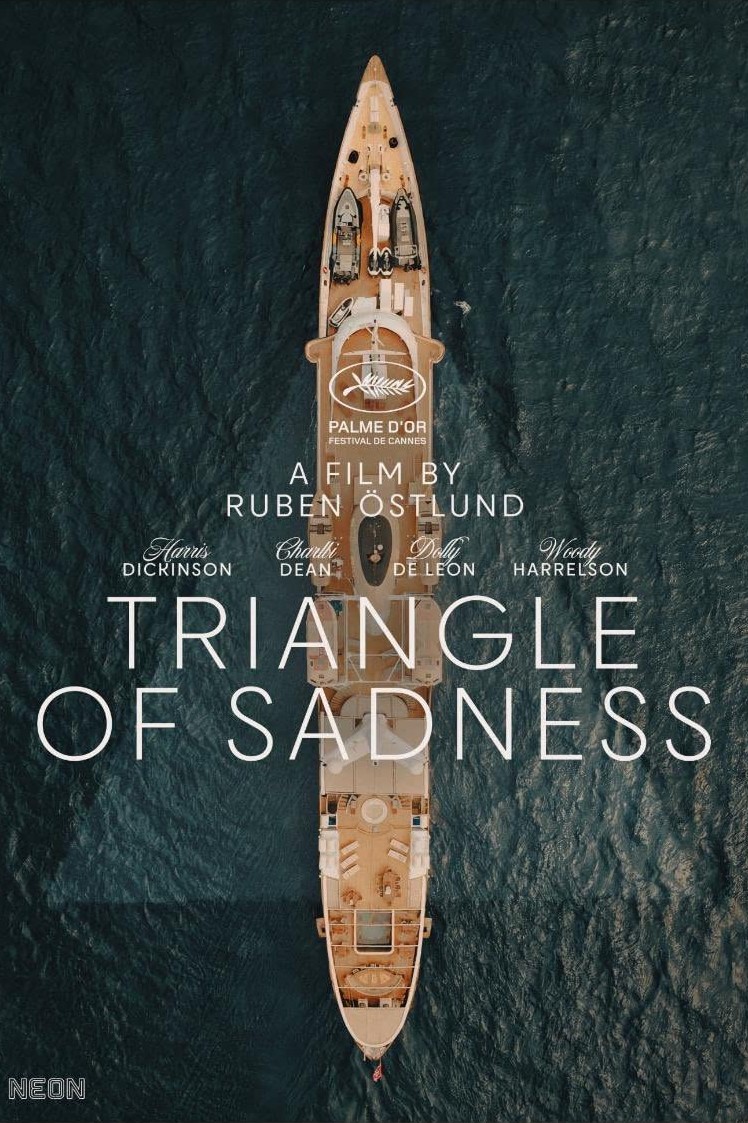
Triangle of Sadness (2022)


It's hard to fit "Triangle of Sadness" in a genre, but probably that would be again a dark comedy turning into drama if I'd be forced to pick some category. However, it's an entirely different type of movie than last time's "Banshees of Inisherin". It's also quite complicated to write a spoiler-free review sufficiently eloquent for what we have here. Or I don't have enough inspiration to do it now. That's why I did something that I typically only do before watching a movie, not after = to also have a look at what others wrote. It seems to me, however, that my opinion diverges from the majority, so I'll stick to the essentials.

The movie's split into three acts, the first introducing a couple, Carl and Yaya, two fashion models, somewhere close to their 30s. The second act brings them on a yacht cruise together with all kinds of wealthy but disagreeable characters. The captain of the ship, himself a very special character, always drunk and upset about the capitalist regime he's part of finds a drinking buddy in a Russian oligarch, and ultimately drives the ship to its doom. Or otherwise said, he brings the movie to its third act, where we have a handful of survivors shipwrecked on an island, and forced to adapt their lavish living to a Robinson Crusoe existence. That's the summary in a few words.

"Triangle of Sadness" is a pretty objective movie relative to the current reality and a quite direct one. That's where the criticism stems from, apparently for "lack-of-depth", as I've seen in some reviews close to Hollywood (in Europe it was received ok). I think the real reason behind it is a different one. The movie probably doesn't fit well with a political agenda very firmly oriented in a certain direction during the last few years, which I'm not really in the mood to debate here. Setting some base on "the rich aren't nice" image, the movie first enters some cliches showing the superficiality behind luxury, which is not something new indeed as reviews say, funny enough turning this into low ratings. The last act drives us to some reversing within the social ranks, the control being taken by a former cleaning lady on the yacht, apparently the only one with the necessary practical skills for surviving. This outcome slowly turns the tide towards some exploitation or even tyranny perspectives, and the new group leader feels very well in her position. The essence here (or the probably inconvenient "depth") is that not even the "equality" naturally created by the sunken ship can resist as it would be believed it can. Or at least that pushing to extremes when trying to create equality won't hold, the attitude in commercials can't be standard - sometimes depends on the brand, Thursday is not a day as any other to have dinner despite weather forecasts, a ship's crew cannot indulge in leisure activities as much as the passengers do, not all ships have washable sails, having the stomach full is not a universal recommendation for sea sickness, you can't say "yes" all the times to what's requested from you, and maybe others, maybe even more "deep", that wrap up into the same idea.

Rating: 4 out of 5

Wednesday, January 4, 2023

The Banshees of Inisherin (2022)

"The Banshees of Inisherin" is the fourth feature film written and directed by Martin McDonagh after "In Bruges", "Seven Psychopaths" and "Three Billboards Outside Ebbing, Missouri". At the first sight it could fit the same line of dark comedy as the predecessors. That's until it becomes clear that it's much more dark and much less a comedy.

Somewhere on Inisherin, a fictitious island on the Irish coast, at the beginning of the 20th century, two glass mates, Colm and Padraic, abruptly get into a conflict. The reason, Colm, the eldest of the two, and having some talent of playing the violin, decides that his life is wasted in useless chit-chat. So, without explaining much, lets his former friend know that there's nothing to be dicussed between them and that he's busy with composing a new tune. The news is a real shock for Padraic, disrupting without warning a routine where pretty much the only "entertainment" on the island were the afternoon chats at the local pub with his buddy. Confused, Padraic tries to make Colm change his mind, but his attempts hit a rock. Moreover, to prove that he's not kidding, Colm threatens to cut one of his fingers each time he's approached in conversation. The situation seems funny initially, but slowly escalates to a typhoon disturbing the peace of the small local community.

I vaguely remember that also "In Bruges", starring the same Colin Farrell and Brendan Gleeson, switched from comedy to drama, but here it happens quicker and more harsh. Even if in the first part of the movie the action seems sometimes to drag. The humor is not lost though, and it's really good, but it slowly gets to having more of a tension relief role, which is really needed. As a drama, "The Banshees of Inisherin" is much more complex than the summary above might suggest. There are a lot of ideas that can be drawn from what we see here. From the amount of risk in someone's life that a strict separation between black and white can create to the difficulty of leaving a comfort zone and its consequences but as well the lack of understanding of such situations, and others. These many senses seem somehow to contrast the small number of characters and the geographic isolation. The entire community that interacts with the two main leads is limited to a number below 10 (+ 2 animals), out of which more present in the action are actually just Padraic's sister and the son of the local policeman, where we have another mini-drama as a side-story. I guess, however, that actually this reduced context creates an opportunity, such that each character can be carefully crafted and integrated in the script, so that finally what you get is a rich picture of an isolated corner of this world. A picture that is completed by a tragic but open ending, reason why it might be a bit disappointing. Even though, if you want you can see here some tiny hope for a happy-end. It really depends on which half of the glass you prefer ;)

Rating: 4 out of 5

Saturday, November 12, 2022

Trois couleurs: Blanc (1994)


For the 15th year of my blog, I intended for a subject worthy enough of a round anniversary. Obviously, I didn't have enough time to find anything new and I'm again forced to recycle something. This spring, if I remember well, I've rewatched Kieslowski's colors trilogy, supposedly connected to the French Revolution symbols through the well-known colors of the flag - bleu, blanc, rouge. I've always found it a bit overrated, maybe except for the second movie, "Blanc". In essence, it's a comedy, slightly bitter, but that's what makes it special.

Karol Karol is a Polish barber, who recently arrived in Paris, and even more recently left without a dime by his ex-wife after a quick divorce motivated by his incapacity to perform his duties as a husband. Losing his passport, without speaking much French, and with his hair salon set on fire by his former wife, he ends up with a big empty suitcase as a beggar in the metro station, singing with a pair of... combs. The Polish tune catches the attention of Mikolaj, another Polish guy, considerably more wealthy, who offers a deal - to kill somebody who wants to die but doesn't have the guts to do it by himself (we finally find out that "the somebody" is Mikolaj, but let's save some of the story). Karol says no, but Mikolaj finally decides to help him by arranging an illegal journey to their home country, packing Karol in his empty suitcase. Long story short, Karol gets back to Poland barely alive, and slowly starts building a revenge plan. How does that go? It's probably better to watch the movie than read it here :)

Unlike the rest of Kieslowski's trilogy, "Blanc" is more a Polish production than a French one. Besides the story, slightly unrealistic at some point, but dense enough to keep you watching - we definitely have a subject here and it's probably better to keep the current entry spoiler-free - we have very well-picked casting. The score is also surprisingly good and allowed me to discover Zbigniew Preisner (the composer), my only reference until then in Polish film music being Wojciech Kilar. The cinematography is nice, but that's valid for the entire trilogy. Each movie shows an obvious intent to bring forward as much as possible the color set in its title.

As far as I know "Blanc" is mostly considered by film critics a good movie, but still the weakest of the three. Maybe because it's the one with a rich plot, drawing attention there instead of being centered on deep philosophical questions. Concerning that, I didn't care much about the references it draws to "egalite" = the middle link between the "liberte" and "fraternite", as it's considered to be, but I've seen it simply as a stand-alone picture. A "revenge movie" in the end, which surprisingly presents itself this time as a comedy packed within a drama. Or the other way around :) Pretty much like the life of the main character. Maybe that's a reflection theme that's deeper than others ;)

Rating: 4 out of 5

Tuesday, August 23, 2022

Kundun (1997)


It's been a while since I've watched "Kundun", and unfortunately I didn't have time to write a fresh entry. So, we'll deal with one a bit more stale, but somethin' is better than nothin'.

The movie, directed by Martin Scorsese, relates the history of the last living Dalai Lama since his early childhood up o the exile in India forced by the Chinese troops invading Tibet. It's debatable how well the movie presents the main points of Dalai Lama's ruling as the de facto leader of the second largest Chinese province. It's also debatable what connection you can draw, in the sense of "history repeats itself", between what happened more than 60 years ago in the far east and what happens now in the closer east. But this is not a blog for politics :) So, thinking on some of the latest more or less controversial positions expressed by a man that got through most of his life, probably it's more important to get to live in peace and harmony with the people around you indiferent of their urge for singing whatever national anthem. So, let's keep things peaceful and get back to the movie.

It's neither the best, nor the worst film made by Scorsese. It's definitely not on par with Bertolucci's "The Last Emperor", but it has its own merits and some distinct nuances still raising it to the level of a classic epic movie. First of all, I don't know if there's any known name in the entire cast. On the contrary, there are quite a few actors for whom this was their only movie in their cinematographic career. I'm not sure how Scorsese worked here = how many are amateurs, how many are stage actors, etc - but there's nothing to complain in the end. Besides Dalai Lama, we have some other characters with relatively consistent parts, like the chancellor for example, an excellent actor who in his real life is actually a tibetan painter. The cinematography of Roger Deakins and the minimalistic score of Philip Glass transform the movie in a visually-audible jewel. There are movie with a good subject, but where you have moments when you just drop out of the story, just to better sense some seconds or minutes of camera work mixed with sound. That's what I like to call "cinema movies", because there you get the max effect out of this. Well, getting over all the small issues in the story, maybe some lightness in dealing with a heavy subject here and there, and an ending that's a bit abrupt, for me "Kundun" remains a "cinema movie" - and there are less and less that provide this feeling.

Rating: 4 out of 5

Monday, August 1, 2022

Secrets & Lies (1996)

IMDb double tags "Secrets & Lies": comedy + drama. Unfortunately IMDb doesn't also mention how much of the one or the other you get, and I assume the ordering is alphabetical. So, a warning - what we have here is about 95% drama, a maybe a 5% of bitter comedy. Fortunately, that doesn't spoil the movie (well, at least if you're not looking for a comedy).

The development is a bit long, even though it somehow follows two lines of action. We're introduced in the life of a family living in the London suburbs of the '90s. On one side we have a single mother of modest condition, a factory worker, close to depression and in constant conflict with her soon-to-be 21 years old daughter. Give the occasion, the uncle, a photographer somewhat more successful in life, at least financially, tries to plan a barbecue reunion. Meanwhile, an adopted optometrist, decides after the death of both her parents to search for her natural mother. Probably it won't be a great surprise where the investigation leads.

The movie is built on top of this story, maintaining a slowly but steadily increasing tension level up to the climactic meeting in the end. The risk is to get you bored if you're not patient enough to digest all the symbolic elements - for example, the photo sessions that insist on the idea that there aren't any ordinary people free of troubles. All this slow development is meant to also define in more detail the characters, the actors doing an amazing job. The characters are relatively diverse, so until the end there is a chance to start relating with one or the other. That's probably the main strength of the movie, because otherwise it doesn't excel technically. Probably the screenplay could be easily adapted to a stage play. The finale comes with a predictable climax, but is also somehow cathartic, which, depending on the person, could exert a strong impact. Not necessarily concerning the family situation in the movie, but the generally entangled family situations where it's sometimes awfully hard to maintain a balance. But well, as someone told me once, "families are always getting complicated" :)...

Rating: 4 out of 5

Sunday, April 24, 2022

The Age of Innocence (1993)


Most probably five, ten years ago, or maybe even two or three, I would've been terribly bored by two hours of romance-drama mix set at the end of the 19th century. Now, however, "The Age of Innocence" was... comforting; I guess that's the best one-word decription I could use.

I didn't read the novel, but I was expecting something between "Howards End" and any adaptation based on Jane Austen's works. It didn't thread far from that. The surprising part was to find this to be the most non-Scorsese movie out of all the movies I've watched directed by Scorsese. The cinematography by Michael Ballhaus, even though it's clearly not the single collaboration between the two ("Goodfellas", "The Departed", "Gangs of New York"), it's probably more close to the camera work in Coppola's "Dracula", and has some very peculiar nuances (e.g., without any specific reason, we're treated very often with frequent insertions of... food frames :)). The score by Elmer Bernstein fits perfectly, although if you'd separate the soundtrack from the movie it might seem very old school, more towards the '60s-'70s. Finally, the cast, excepting Daniel Day-Lewis, doesn't seem to have many other names in common with the usual list of actors we see in Scorsese's movie credits. What's certain is that all of the above, under his direction, sums up to a movie that doesn't really fit on a home screen. I didn't have the feeling of watching something so clearly made for cinema for quite some time. And considering my 27 inch screen + headphones, unfortunately the reason for that it's not that I have some cinematic experience conditions at my place and I can't make the difference anymore. It's strictly about how cinematic the movie is ;).

I sort of skipped the subject this time. Maybe because 'til the end of the movie what's above was more significant to me, and "the story" was left behind. Briefly, this is about a love triangle in the New York's pre-1900 high society - and all the context seems somehow supperficial. Upt to a point, where, suddenly, and again surprisingly, the development takes a very mature turn as reflection on life & relationships. But, probably that's where the movie's importance falls short, and the book prevails, which as I mentioned, I haven't read. A good extra reason to stick to my spoilers free policy and end this here ;)

Rating: 4 out of 5

Monday, February 14, 2022

Drive My Car (2021)


"Drive My Car" is a long slow movie. So long and so slow that the intro credits come after more than half an hour into it. But it's a "slow burn". In different words, I think it's worth getting to the end of it.

The movie's based on a short writing of Haruki Murakami. Also, it's very entangled with "Uncle Vanya" by Checkhov. Unfortunately, my readings never intersected with the two, and that I think made me lose some of the hidden meanings in the action. This is centered on a period from the life of Kafuku, a theater actor from Japan in his 40s, who's losing his wife in the beginning of the movie as a victim of brain hemorrhage. Fast forward two years from the tragic event, we find Kafuku as a director somewhere in a delegation, tasked with staging the mentioned Checkhov play. The rules of the theater company require him to take a professional driver, a young woman. Initially he's displeased with this, on the ground of breaking his habit of rehearsing the play lines while driving, but he's finally compelled to accept. From here on, the movie starts more often to signal the "slow burn" I was mentioning, delivering between periods of calm some scenes that are either thought provoking or their construction is sufficiently strong to keep you hanging on. Probably one of the first such scenes is when the casting of the play takes place, where a former lover of the deceased wife shows up, a character to whom Kafuku surprisingly decides to give the title role. But let's leave the rest of the story for the viewing I'd say. There's not much of a twist in it after all - the whole charm of the movie's set in its construction with all the details, and a summary in this case would not make justice on giving you the same impression as the complete package.

There's a symbolism in this movie from which you can understand more or less, either as you want to perceive it or how the director intended :) What's important is that's there and keeps your mind busy, from the red SAAB with the wheel on the left driven a lot over Japanese roads, only to find it in the end on a Korean highway where the rule is "drives on the right", up to the interference between Checkhov's lines in repetitions and the moments in the lives of the people saying the words, when you're not sure anymore what's part of the play and what's real. In brief, the direction and the script are top notch, although probably the most obvious contribution to the impact of the movie comes from the actors' side, in particular from the lead.

It's hard to qualify "Drive My Car" as a niche movie, because it doesn't move much beyond the usual pattern of a drama. One thing that's certain though is that's not a movie for everyone. I doubt that 10 years ago, maybe even one year ago, I would've had the patience to digest this properly. I'm not sure I did it now, or better said I'm pretty sure there are more meanings in it than I was able to discern. It's a movie that requires some dose of life experience to understand the feelings of some characters, to be able to empathize with them, at least in part. And if that doesn't happen there are good chances the movie will be dreadfully boring for you. Besides that, it's a movie that has a lot of the typical Japanese calm in its action development - which again you might be able to get a taste of if you're in a period when you unconsciously need it. Then, I can say it's relaxing, and you'll feel that stronger as you watch it. Otherwise, I guess I would've slept through it. But I didn't, and the ending, more or less bitter, brings you one of the best acted scenes I've ever seen in a movie, a dialogue from "Uncle Vanya" partly said using the sign language, and which in essence could be summarized in a line from a previous scene - "we must keep on living".

Rating: 4 out of 5

Monday, January 3, 2022

The Milagro Beanfield War (1988)


Three days ago, I was looking again for a cinematic "sleeping pill", and so I ran over "The Milagro Beanfield War". A totally wrong choice for the intended purpose, as I found out after watching it. And when I found out I decided I must write a blog entry about it. So here we are...

The movie is directed by Robert Redford, which "recommended" it for my search. With all respect for his acting skills, I don't think there's any other directing attempt from Redford to impress me in any way. It's true I've never got to watch "Ordinary People", considered probably his best movie, but out of the rest of what I've seen the script or the subject typically saved the movie, and the directing always felt somewhere between bland and absent. That's why here I had a shock, experiencing exactly the opposite.

There's no complicated subject in this movie. We're somewhere close to the US border with Mexico, in Milagro, a small forgotten town, with a predominantly hispanic population, close to its extinction being overshadowed by a residential complex in development. In this setting we find Jose aka Joe Mondragon who dares the unthinkable - to use water spilled from the property of the landlord who bought almost the entire region to irigate his own field of beans. People start talking, panicking and get close to rioting, splitting between the two sides - pro and agains the capitalst opression. And like that, we get a series of events that lead to a mini "revolucion". What's really catchy in the movie is how this series of events is staged...

I'd say that although produced more than thirty years ago, the movie fits quite well with the more recent trends, drawing some clear lines like anti-system and others. I'm more and more bored of overusing stuff like that in a media like movies, where in more than one hundred years propaganda was way too often present (whatever kind of that was), trying to overshadow the artistic or even the entertainment side. However, unlike the increasing accent on such direction in the latter years, here I can appreciate the fact that this comes second, much less obvious than in many recent movies, and that's thanks to the direction. The movie has a character and situation comic that's so present, fortunately raising on top of other nuances and preventing these to become too.. "aggressive" (maybe less in the end). It's an excellent mix between the acting, the symbolism, a bit of romance, a bit of fantasy, and lots of humor. The actors have a merit, the script has its merit, the score has a merit, but on top of everything, it's clearly, by far, the best movie directed by Redford I've seen by now, and I think the direction has the largest merit in the final result.

Rating: 4 out of 5

Sunday, September 12, 2021

Les misérables (1995)


I don't remember writing any blog entry that could be labeled as "paying tributes", and I doubt the current one would fit something like this. But my subject for this week was not that good anyway, so I thought it might be a better call to shortly point out at least one movie starring Jean-Paul Belmondo, IMHO the most versatile actor France had in the last 100 years. And I think "Les miserables", the '95 version, is eloquent of this versatility. There are many years since I've last seen the movie, so I won't try any detailed summary because my memory won't help me. It's not a classic adaptation of the novel. The story is set during WW2, instead of the French Revolution. It's actually a parallel over time that probably could be extended more. So, even my last viewing of this is far from fresh, I think I've seen the movie like three times or so, enough to stick in my reference book as the best adaptation of Hugo's novel, although it's not an adaption of Hugo's novel. The credit for this is shared by both Belmondo in the lead role - a character built as a replica of Jean Valjean, as well as by Claude Lelouch as director and writer. And that's pretty much all I had to say.